When a Good Deal Costs More Than We Think
Black Friday may bring the conversation about consumption into focus, but its questions deserve attention year-round. This article explores the hidden costs of unnecessary purchases, the psychology of discounts, and practical ways to shop more intentionally without guilt, deprivation, or unrealistic expectations.
Every November, the language of shopping becomes more urgent. Limited-time offers, early access promotions, countdown clocks, and promises of exceptional savings appear across our screens. Even when we have no plans to buy anything, it can feel as though we're missing an opportunity.
Black Friday is one of the most visible examples of this pressure, but the underlying message is familiar throughout the year: there is always something newer, better, more convenient, or more desirable waiting to be purchased.
The difficulty isn't necessarily shopping itself. We all need things, and sometimes a well-timed discount makes an essential purchase more affordable. The question is what happens when the opportunity to save becomes the reason we spend.
Conscious shopping offers a different approach. It encourages us to consider what we need, what we already own, what we can reasonably afford, and how our purchases fit into our lives.
Buying less isn't about refusing every pleasure or turning consumption into another measure of personal responsibility. It's about creating enough space between wanting something and purchasing it to make a choice that feels considered rather than automatic.
What Does It Really Mean to Buy Less?
Buying less means reducing purchases that don't meaningfully serve our needs, preferences, or circumstances. It doesn't require a fixed number of possessions, a minimalist home, or a commitment to stop shopping.
For one person, it might mean buying fewer clothes and taking better care of the ones they already own. For another, it could involve planning household purchases, choosing refurbished electronics, or resisting the temptation to replace something that still works.
The important distinction is between intentional consumption and habitual consumption.
Intentional consumption considers the purpose, usefulness, affordability, and potential consequences of a purchase. Habitual consumption is more likely to be influenced by convenience, advertising, emotion, or the simple availability of something new.
Neither distinction should become a judgment about the person making the purchase. Shopping decisions happen within real financial, social, and practical circumstances.
A family replacing worn-out school supplies, someone purchasing accessible clothing, or a person taking advantage of a genuine discount on an essential appliance may be making a thoughtful decision even if it involves buying something new.
The goal is not to own as little as possible. It is to own and purchase what supports a life we actually live.
The Environmental Cost of Things We Don't Need
Every physical product has a material history that begins before it reaches a store.
Raw materials must be extracted, grown, or processed. Products are manufactured, packaged, transported, used, and eventually repaired, resold, recycled, or discarded. Each stage can require energy and resources and may create pollution or waste.
The scale and type of impact vary considerably. A cotton shirt, an electronic device, and a wooden table have different supply chains, material requirements, and environmental consequences. Their longevity and how frequently they are used also matter.
According to the United Nations Environment Programme's Global Resources Outlook 2024, the extraction and processing of natural resources are major contributors to global environmental pressures, including climate change, biodiversity loss, and pollution.
This is one reason reducing unnecessary demand can matter.
Why using what we already own is often valuable
Keeping a functional product in use can delay or avoid the need for a replacement. Repairing a jacket, maintaining a household appliance, or continuing to use a working phone may reduce demand for additional manufacturing.
However, longer use isn't automatically the lowest-impact choice in every situation. Some older appliances consume considerably more energy than efficient replacements, and certain damaged products may no longer be safe to use.
The more useful principle is to consider the product's entire life cycle rather than assuming that either keeping or replacing it is always the better option.
Before replacing something, we can ask whether it still works, whether it can be repaired, and whether a replacement would offer a meaningful improvement.
The overlooked problem of buying sustainable products unnecessarily
Sustainability marketing can create an unusual contradiction: encouraging people to consume more in the name of consuming responsibly.
Reusable bottles, canvas bags, storage containers, and products made with recycled materials can serve useful purposes. But purchasing multiple versions of something we already own may undermine the environmental benefits we hope to achieve.
A product doesn't become necessary simply because its packaging emphasizes natural materials, recycled content, or environmental responsibility.
A useful first step in sustainable consumption is often surprisingly ordinary: use what is already available before shopping for a supposedly greener alternative.
The Emotional Cost of Constant Consumption
Shopping is not always a purely practical activity.
A purchase might represent comfort, celebration, self-expression, convenience, or the hope of becoming a slightly different version of ourselves. There is nothing inherently wrong with enjoying beautiful things or occasionally purchasing something simply because it brings pleasure.
Problems can arise when shopping becomes an automatic response to stress, boredom, social comparison, or a feeling that what we have is never quite enough.
Marketing frequently connects products with desirable identities and experiences. Clothing may be presented as confidence. Home decor may promise a more peaceful life. New technology may suggest greater productivity or belonging.
These associations can be compelling because they speak to real human desires, even when the product itself cannot reliably deliver the emotional outcome being suggested.
Why a discount can make an unnecessary purchase feel reasonable
Behavioral economics helps explain some of these decisions.
Anchoring occurs when an initial number influences how we evaluate a later one. A jacket displayed at $150 and reduced to $75 may seem particularly attractive because the higher price becomes our reference point.
But that comparison tells us little about whether we need the jacket, whether it is well made, or whether $75 is affordable.
Scarcity and urgency cues can also affect decisions. A countdown timer or limited-stock message may encourage a quicker response by making an opportunity seem temporary.
Not every limited offer is misleading. Inventory can genuinely be limited, and promotions do end. The concern is whether these messages leave enough room for a considered decision.
A third influence is the fear of missing out. When friends, creators, and retailers repeatedly share what they're buying, participation can begin to feel like an expectation rather than a choice.
Recognizing these influences doesn't make someone immune to them. It simply makes it easier to notice when the excitement surrounding a purchase is becoming more important than the purchase itself.
How to Recognize Misleading Discounts
A large percentage displayed beside a product is not, by itself, proof of a good deal.
To evaluate a discount, we need to understand what the advertised price is being compared with.
For example, imagine a product advertised as follows:
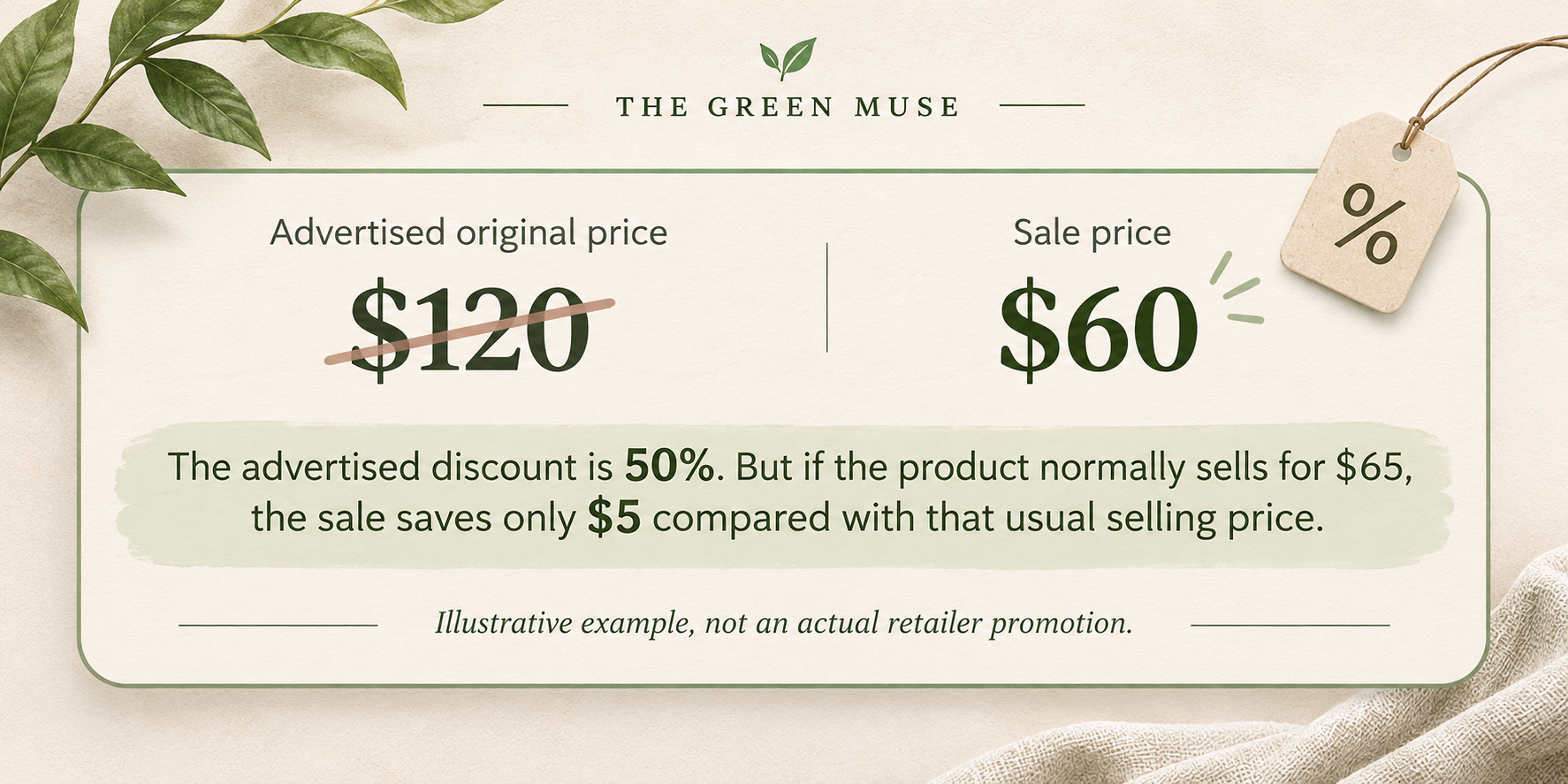
This is why the reference price matters as much as the percentage.
In the United States, the Federal Trade Commission provides guidance on deceptive pricing practices, including comparisons with former prices that may not represent genuine previous selling prices.
Consumers can protect themselves by looking beyond the promotional label.
Compare actual selling prices
If a purchase is planned, check prices at more than one retailer. Where reliable price-history information is available, it may help determine whether a promotion is unusual or simply part of a retailer's regular pricing pattern.
Be sure to compare equivalent products, including size, model, materials, warranty, and included accessories.
Calculate the complete cost
Shipping charges, taxes, subscription requirements, maintenance, and return costs can change the value of an offer.
A lower sticker price is not always the lowest overall cost.
Be cautious with urgency
Messages such as "only a few left" or "offer ends soon" deserve attention, particularly when they appear repeatedly or make it difficult to compare options.
The FTC has also examined dark patterns, a term describing design practices that can manipulate consumer decisions. Examples include misleading countdowns, hidden fees, and interfaces that make unwanted purchases or subscriptions difficult to avoid.
Consider the purchase independently of the discount
Perhaps the most revealing question is whether we would still want the item if it were displayed without the original price, bright promotional graphics, or a countdown clock.
A discount can make a necessary purchase more affordable. It cannot, on its own, make an unnecessary purchase necessary.
How to Shop More Intentionally Without Feeling Deprived
Conscious shopping becomes more sustainable as a habit when it accommodates real life.
Rigid spending rules can be difficult to maintain, particularly when circumstances change. Unexpected household needs, children growing out of clothing, changing health or accessibility requirements, and financial pressures can all affect what we purchase.
A more flexible approach begins with understanding the purpose of a purchase.
Give yourself time to decide
For nonessential purchases, consider waiting until the initial excitement has passed.
That might mean leaving something in an online cart overnight or adding it to a wish list and returning to it later. The exact waiting period matters less than having an opportunity to reconsider.
Essential or time-sensitive purchases don't need to follow the same rule.
Shop from what you already own
Before buying something, look for alternatives at home.
An outfit may feel new when familiar pieces are combined differently. An existing container may work just as well as a specialized organizer. A small repair may restore an item that seemed ready for replacement.
This isn't about forcing yourself to make do with unsuitable belongings. It's about recognizing the usefulness of what you already have.
Choose quality according to actual use
A higher price doesn't guarantee better quality, and the most expensive option isn't necessarily the most sustainable.
Look at construction, materials, maintenance requirements, repairability, and how frequently the product will be used.
For clothing, this may mean examining seams, fabric care instructions, and whether a garment works with your existing wardrobe. For electronics, software support, replacement parts, and repair options may matter more than an attractive design.
A durable item that you rarely use may be a less practical purchase than an affordable item that meets a genuine everyday need.
Make room for enjoyment
Not every purchase needs to solve a problem or serve an essential function.
Art, books, clothing, hobbies, and thoughtful gifts can enrich our lives. Conscious consumption doesn't require removing pleasure from spending.
It simply invites us to consider whether that pleasure is meaningful to us or primarily shaped by the pressure to keep acquiring something new.
Buying Less When Money Is Already Tight
Discussions about sustainable consumption sometimes overlook an important reality: many people are already limiting purchases because they have no other choice.
For someone managing a strict budget, buying less may not represent a lifestyle decision. It may be a financial necessity.
And choosing the cheapest available option is not necessarily careless consumption.
A person who cannot afford a durable appliance may need to purchase a less expensive one. Someone without access to reliable transportation may depend on retailers with limited selections. Repair services and secondhand stores may be unavailable, inaccessible, or more expensive than expected.
These constraints matter.
Conscious shopping advice should never assume that everyone has the same time, income, access, or freedom to choose.
Buying an affordable item that meets an immediate need can be a responsible decision. So can purchasing something new when secondhand alternatives are unsuitable, unsafe, or unavailable.
The responsibility for reducing environmental harm also extends beyond individual shoppers. Manufacturers, retailers, policymakers, and waste-management systems influence how products are designed, marketed, repaired, and disposed of.
Individual choices matter, but they cannot substitute for broader improvements in production and consumption systems.
When Buying Something New Is the Right Decision
Buying less is not the same as avoiding purchases that improve safety, accessibility, comfort, or quality of life.
Replacing an unsafe appliance, purchasing supportive footwear, or investing in a reliable work tool may be entirely reasonable.
Sometimes replacing an item is more practical than repairing it, particularly when repairs are expensive, parts are unavailable, or continued use creates safety concerns.
The same applies to choosing new rather than secondhand products. Used goods can be valuable alternatives, but their condition, hygiene, safety, and suitability should be evaluated individually.
The most useful question is not simply whether a purchase can be avoided.
It's whether the purchase makes sense for the person making it, considering their needs, resources, and available alternatives.
A More Thoughtful Approach to Black Friday
Black Friday doesn't have to be treated as either an obligation to shop or an event to reject entirely.
For some households, seasonal promotions provide an opportunity to purchase planned necessities at lower prices. For others, avoiding promotional emails and shopping apps may help reduce unwanted spending.
Both approaches can support conscious consumption.
If you plan to shop during a major sale, begin with a list of items you already intended to purchase. Establish a realistic budget, research typical prices, and compare options before the promotions begin.
Avoid adding unrelated products simply to qualify for free shipping or a larger discount. Spending more to unlock a promotion may cancel out the intended savings.
And if nothing on your list is discounted, there is no requirement to buy anything.
The absence of a purchase is not a missed opportunity when there was no genuine need for one.
Practical Takeaway: A Simple Pause Before Purchasing
The next time you consider buying something, try asking yourself three questions:
What purpose will this serve? Consider whether the item meets a genuine need, supports something you value, or brings enjoyment you expect to appreciate.
Do I already have a suitable alternative? Think about what you own, whether it can be repaired, or whether borrowing or buying secondhand makes sense.
Does this purchase work for my budget and circumstances? Consider the full cost, expected use, and whether you're comfortable with the decision independently of the promotion.
These questions aren't a test you need to pass. They're a way to make the decision more deliberate.
Over time, small moments of reflection can help us recognize patterns in what we buy, what we use, and what we eventually regret purchasing.
Frequently Asked Questions
-
Reducing unnecessary purchases can help limit demand for new materials, manufacturing, transportation, and disposal. However, the environmental benefits depend on the products involved and what happens instead. Repairing or extending the life of an item is often worth considering, but product safety, efficiency, and durability also matter.
-
Yes. Shopping during Black Friday is not inherently inconsistent with sustainable living. A planned purchase at a genuine discount can be financially sensible. The important considerations are whether the item serves a purpose, whether the price offers real value, and whether the purchase fits your circumstances.
-
Compare the current price with the product's usual selling price, check equivalent offers from other retailers, and account for shipping, taxes, and other costs. Be cautious of inflated reference prices and promotional messages that create pressure to decide immediately.
-
No. Using what you own, repairing items, borrowing, and purchasing suitable secondhand products can all support more resource-conscious consumption. Expensive products aren't automatically more responsible, and affordability is an important part of making realistic decisions.
-
Start by reviewing the return policy if the product is unused and eligible for return. If returning it isn't possible, consider whether it can be used, gifted, resold, or donated responsibly. One regretted purchase doesn't define your shopping habits. It can simply provide useful information for future decisions.
Rethinking What Enough Looks Like
There is no universal definition of enough.
Our needs change with our health, families, work, interests, and circumstances. What serves us well today may not be appropriate several years from now.
The value of buying less lies in being able to recognize those changes without assuming that every new desire requires a new purchase.
It means appreciating what we own, making room for things that genuinely improve our lives, and allowing ourselves to walk away from offers that don't.
Sometimes a thoughtful purchase is the right choice. Sometimes it's a repair, a borrowed item, or a decision to wait.
And sometimes, after considering everything, we discover that we already have enough.
The Conscious Shopping Checklist
A thoughtful pause before your next purchase. Check what you've considered. There's no perfect score.
Your circumstances matter. This checklist is here to support thoughtful decisions, not to judge them.
When You Do Need Something, Explore Your Options
Conscious shopping isn't about avoiding every purchase. It's about making choices that reflect our needs, values, and circumstances.
When buying something new makes sense, taking time to learn about the brands behind our purchases can be worthwhile. How products are made, what materials are used, how long they might last, and what a company shares about its practices can all help us make more informed decisions.
At The Green Muse, we've organized a directory of brand partners across conscious living, household essentials, fashion, wellness, and everyday lifestyle categories. It's a resource for exploring options, asking better questions, and discovering businesses you may want to research further.
Not every brand or product in the directory meets the same environmental or ethical standards. We encourage you to evaluate individual products and company claims rather than relying on labels alone.
Explore The Green Muse Brand Partners
View Our Brand Partners Directory
Affiliate transparency: Some brands in our directory have affiliate or collaboration relationships with The Green Muse. We may earn a commission from qualifying purchases made through eligible affiliate links, at no additional cost to you. Our goal is to provide useful information, not encourage unnecessary spending.
And remember, you don't need to buy something to make a conscious choice. Sometimes the most meaningful decision is to appreciate what you already have.
The Green Muse
Conscious choices. Thoughtful living.
Sources & Further Reading
Explore the original research and consumer-protection guidance informing this article.
01 Global Resources Outlook 2024 UN Environment Programme · International Resource Panel
Examines global resource use and its environmental impacts, including pressures associated with extraction, production, and consumption.
Read the UNEP report →02 Guides Against Deceptive Pricing Federal Trade Commission · 16 CFR Part 233
Provides federal guidance concerning deceptive price comparisons, including advertised former prices and other reference-price claims.
Read the FTC guidance →03 Bringing Dark Patterns to Light Federal Trade Commission · 2022
Examines manipulative digital design practices, including misleading countdown timers, disguised advertisements, hidden fees, and confusing subscription processes.
Explore the FTC report →-
At The Green Muse, we believe that conscious living begins with curiosity, compassion, and access to trustworthy information. Through our articles on sustainable living, ethical fashion, mindful consumption, and animal welfare, we aim to make thoughtful choices more accessible without encouraging perfection or unnecessary consumption.
Transparency, editorial independence, and respect for our readers guide how we research, create, and maintain our content.
Editorial Integrity & Research
Our articles combine independent research, credible publications, publicly available information, and thoughtful editorial analysis. We may use digital research tools, trend analysis, and AI-assisted platforms to help gather, organize, and review information.
All content is reviewed before publication, with sources cross-checked where practical. We recognize that research evolves, information can become outdated, and no source or technology is infallible.
Our articles are intended to encourage informed decisions and further exploration, not to present any single lifestyle, product, or approach as the only responsible choice.
Affiliate Links & Brand Partnerships
Some articles contain affiliate links. When readers make qualifying purchases through these links, The Green Muse may earn a commission at no additional cost to them.
Affiliate partnerships help support our independent editorial work. We aim to feature brands, products, and services that are relevant to our content and consistent with our values. Commercial relationships do not guarantee favorable coverage or determine our editorial conclusions.
We encourage readers to consider their individual needs, research products independently, and make purchases thoughtfully.
External Links, Product Availability & Archived Content
Our articles may reference sustainable brands, products, nonprofit organizations, educational resources, and other third-party websites.
As brands evolve, products are discontinued, organizations update their websites, and affiliate programs change, some external links may become outdated, redirect, or stop working altogether.
We review and update content as resources allow, but cannot guarantee the continued availability, accuracy, pricing, or functionality of third-party websites and links. The inclusion of an external resource does not constitute an endorsement of every product, policy, or practice associated with that website.
Older articles remain part of our educational archive and may reflect information available at the time of publication. Readers are encouraged to verify current details directly with the relevant organizations or providers.
Animal Welfare, Rescue Advocacy & Adoptable Pets
Animal welfare is an important part of The Green Muse. Through educational articles, rescue resources, and The Green Muse Adoptables, we help raise awareness of shelter animals, responsible adoption, fostering, and the work of animal welfare organizations.
Our advocacy is independent and primarily volunteer-based. We are not a shelter, rescue organization, veterinary provider, or adoption agency. Unless explicitly stated, featuring an organization or animal does not imply an official affiliation, employment relationship, or financial compensation.
When sharing adoptable animals, we rely on information provided by shelters, rescue organizations, and other authorized sources. We make reasonable efforts to check and update information, but adoption status, location, medical details, and eligibility can change without notice.
All adoption inquiries, applications, and placement decisions must be handled directly by the responsible shelter or rescue organization.
Rescue Resources, Donations & Third-Party Organizations
Links to animal shelters, rescue groups, nonprofit organizations, donation pages, wishlists, and community programs are shared to help readers discover ways to support animal welfare.
The Green Muse does not operate or control these third-party organizations or their websites. We cannot guarantee their current practices, policies, fundraising activities, availability, or outcomes.
Readers should verify donation information, adoption procedures, and organizational details directly before making financial commitments or participating in programs.
Educational Information & Professional Guidance Content published on The Green Muse is provided for general educational and informational purposes.
Discussions involving sustainability, environmental practices, animal health, shelter operations, adoption requirements, and related subjects should not replace guidance from qualified professionals.
For veterinary, medical, legal, or other specialized matters, readers should consult appropriately qualified professionals and the organizations directly responsible for individual cases.
Images, Creative Assets & Copyright
Images and creative materials featured on The Green Muse may come from licensed image libraries, design platforms, participating brands, photographers, shelters, rescue organizations, and other credited sources.
These may include Pexels, Unsplash, Canva, Getty Images, and materials supplied by organizations featured in our content.
Images are used according to applicable licenses, permissions, or other lawful grounds. Unless otherwise stated, copyright and ownership remain with their respective rights holders. Their appearance on our website does not imply that The Green Muse owns the original works or that the creators endorse our content.
Corrections, Updates & Community Collaboration
We welcome corrections and updated information from readers, brands, shelters, rescue organizations, and community partners.
Although we work to maintain accurate and useful content, information may change after publication. If you notice an outdated resource, broken link, incorrect attribution, or an animal profile requiring an update, please contact us.
Your input helps us maintain a more reliable and respectful educational resource for our community.
Contact: hello@thegreenmuseblog.com
Thank you for reading with curiosity, supporting independent content, and helping us build a more thoughtful relationship with the world around us.
