August Main Feature
August Main Feature
Behind ordinary livestock auctions and seemingly promising rehoming arrangements, some American horses enter a commercial trade that ends in slaughter abroad. Understanding how this system works, where protections fall short, and how to rehome horses responsibly can help prevent more animals from entering it.
I’ve always believed there is something extraordinary about horses.
Their quiet intelligence. The trust they can develop with the people who care for them. The way an animal so powerful can also be so sensitive to the world around them.
For generations, horses have worked alongside people, carried us across difficult landscapes, participated in sports, and become cherished companions. Their relationships with humans are part of our history, but their welfare is also our responsibility.
That is why learning about the horse slaughter pipeline has been so difficult for me to accept.
A horse can spend years being loved, trained, cared for, and trusted, only to enter a series of sales that ends far from the life they once knew. Sometimes an owner deliberately sells a horse into the livestock market. In other cases, a horse changes hands repeatedly, and the original owner may have little knowledge of where that animal eventually goes.
Behind this trade are livestock auctions, horse dealers, commercial transporters, and slaughter facilities outside the United States.
Not every horse sold at auction is destined for slaughter. Not every buyer is dishonest. But the existence of a market that purchases horses for slaughter creates a risk that deserves far greater public understanding.
This article is about that system, the animals affected by it, and the choices that can help protect them.
What Is the Horse Slaughter Pipeline?
The horse slaughter pipeline is the network through which horses are purchased, resold, transported, and ultimately delivered to facilities that slaughter them for meat.
In the United States, horses can enter this trade through livestock auctions, direct sales, private dealers, or other intermediaries.
The process does not always follow the same route. A horse might be purchased by a dealer at auction and transported directly toward the border. Another might pass through multiple owners or holding facilities before being sold again.
A simplified example looks like this:
Original owner → Horse auction or dealer → Slaughter buyer → Holding facility → Commercial transport → Slaughter facility abroad
Each transfer can make it harder to trace a horse's history, particularly when ownership documentation and identification are incomplete.
The important distinction is that the slaughter trade does not begin at the slaughterhouse. It begins much earlier, when a horse becomes available to buyers who participate in that market.
What are kill buyers?
A kill buyer is a commonly used term for a dealer who purchases horses with the intention of selling them into the slaughter market.
These buyers may acquire horses through public auctions, private transactions, or other dealers. Their business depends on purchasing and reselling animals at a profit.
Some operate openly as livestock dealers. Others may participate in different parts of the horse market, purchasing animals for resale to various destinations.
It is important not to assume that every dealer or auction buyer is a kill buyer. The concern is the destination of horses purchased specifically for slaughter.
What is a kill pen?
A kill pen generally refers to a holding facility or group of horses associated with a dealer who sells animals into the slaughter trade.
The term is widely used in equine rescue and online fundraising, but it is not a precise legal classification for every facility described that way.
Some horses advertised through kill-pen websites or social media pages may be offered to the public for purchase before the dealer sells them elsewhere.
This creates a complicated situation for animal advocates.
Purchasing a horse from such a facility may save that individual animal from a possible slaughter destination. However, repeated purchases can also provide revenue to dealers who continue acquiring horses.
A photograph, a deadline, and a claim that a horse is about to ship are not sufficient proof of the animal's destination.
That is why transparency, independent verification, and responsible rescue practices are essential.
How Many American Horses Are Sent to Slaughter?
Although commercial horse slaughter for human consumption is not currently operating in USDA-inspected facilities in the United States, American horses have continued to be exported for slaughter in neighboring countries.
According to USDA figures compiled by the Animal Welfare Institute, the number of U.S. horses exported for slaughter has changed substantially over time.
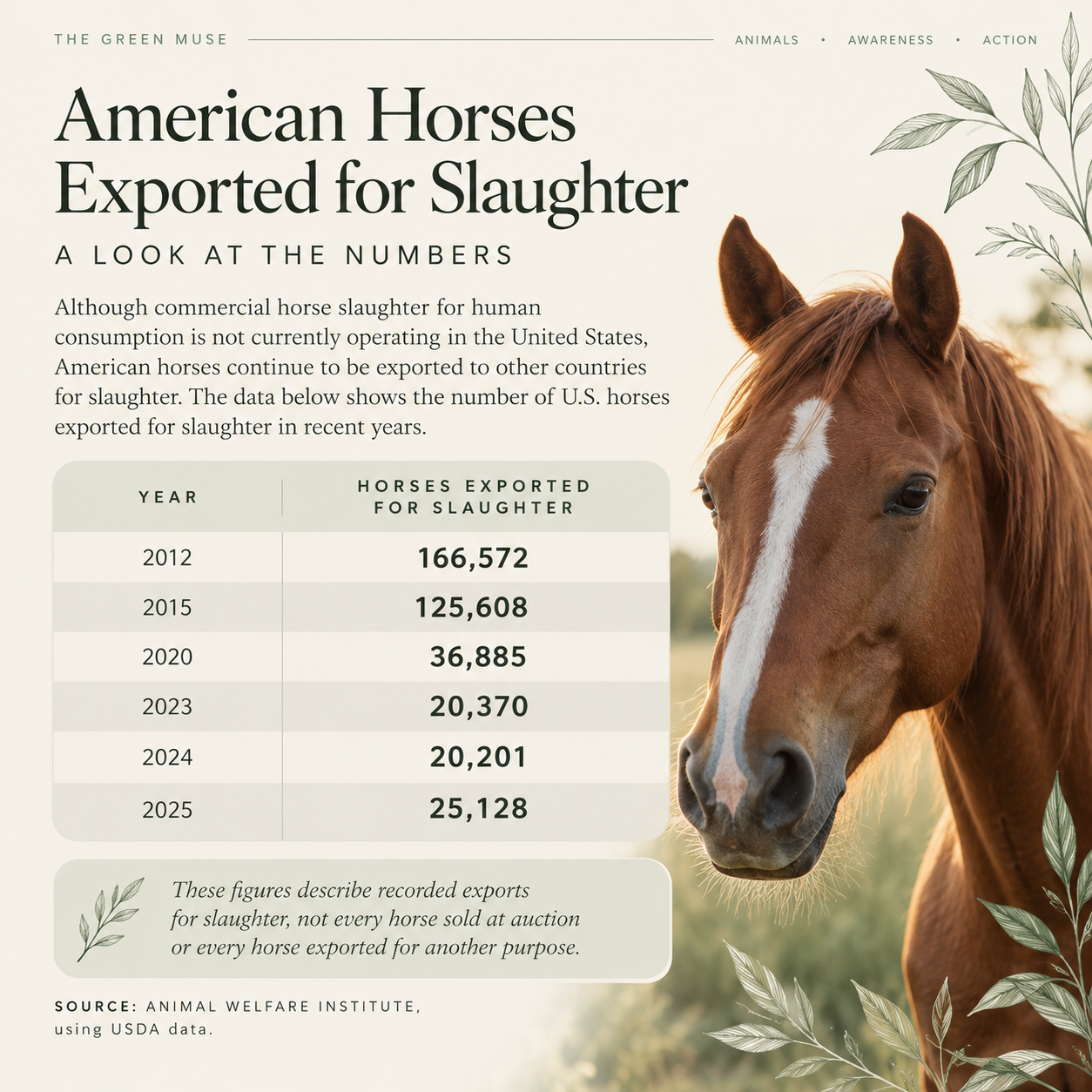
The long-term decline is significant. However, the increase between 2024 and 2025 demonstrates why the issue still requires attention.
These numbers represent individual animals whose lives and histories are largely invisible in the final statistics.
A horse counted in these records may once have been a trail companion, a working animal, a racehorse, or a privately owned family horse.
The statistics cannot tell us how each horse entered the trade or whether the original owner knew the final destination.
They do tell us that the trade has continued despite years of advocacy.
Why Are American Horses Exported for Slaughter?
Horse meat is consumed in some international markets, creating commercial demand for horses purchased and processed for human consumption.
In countries where horse slaughter is permitted, slaughter facilities may purchase animals from domestic sources or import them from elsewhere.
For dealers supplying this market, horses represent a commercial commodity.
That financial incentive helps explain why horses can move through a network of auctions, buyers, and transporters before reaching their final destination.
The existence of a slaughter market does not mean that all horses entering it are old, injured, dangerous, or incapable of being rehomed.
A horse's purchase price, availability, location, and the demand of prospective buyers may influence where that animal ends up.
Why do horses become vulnerable?
Horses can become difficult for their owners to keep for many reasons.
Long-term care requires land or boarding arrangements, veterinary services, farrier visits, feed, transportation, and considerable time.
A change in financial circumstances, illness, family responsibilities, housing, or the owner's ability to provide care can create an urgent need to rehome an animal.
Other horses may become available after retirement from racing, breeding, competition, or work.
Some need specialized care. Others may be healthy but no longer suited to their previous activities.
These circumstances do not make a horse disposable.
They do, however, demonstrate why responsible rehoming requires planning and why accessible equine support services matter.
The Role of Horse Auctions
Livestock auctions are an established part of the horse industry. They allow animals to be sold publicly to different types of buyers.
Some auctions provide opportunities for legitimate purchases, including by experienced horse owners, trainers, and rescue organizations.
However, auctions can also provide access to horses for buyers participating in the slaughter trade.
Once a horse is sold, the original owner may have limited ability to control subsequent transactions.
A horse could be purchased by one dealer, sold to another, and moved to a different location within a relatively short period.
Without reliable identification and ownership records, following that horse through later transactions can be difficult.
This is one reason why surrendering or selling a horse without carefully understanding the process can carry significant risk.
Can a horse be sold for slaughter without the original owner's knowledge?
Yes, this is possible.
A horse might be sold or given away with the expectation that the new owner will provide long-term care. If that person later resells the animal, the original owner may not know where the horse goes.
There are also documented concerns within equine advocacy about misleading representations during rehoming transactions.
However, we should distinguish between verified cases of deception and situations in which a horse simply changes ownership multiple times.
Not every unfortunate outcome involves an intentional scam.
The practical lesson is the same: verbal assurances alone offer limited protection.
Written agreements, buyer screening, identification records, and ongoing communication can reduce risk, although none can guarantee a horse's future.
The Journey Across the Border
Commercial transportation is one of the most significant animal-welfare concerns associated with the slaughter trade.
Horses are large, sensitive animals whose balance, movement, and behavior can be affected by confinement, unfamiliar companions, noise, temperature, and prolonged travel.
During transport, welfare risks may include fatigue, dehydration, injuries, falls, and stress.
The level of risk depends on several factors, including the animals' health, the design and condition of the vehicle, loading practices, stocking density, journey duration, and handling.
Not every shipment experiences the same conditions. Nevertheless, the potential consequences of poor transportation practices are serious.
Are there transportation regulations?
Yes.
Contrary to the impression that slaughter-bound horses travel without any legal protections, the United States has federal regulations governing the commercial transportation of equines to slaughter.
These include requirements under 9 CFR Part 88, administered by the USDA's Animal and Plant Health Inspection Service.
The regulations address matters such as fitness for travel, handling, transport conditions, documentation, and food, water, and rest.
The existence of these rules is important, but regulations are not the same as a guarantee of humane treatment.
Effective protection depends on compliance, monitoring, enforcement, and the ability to identify violations.
What happens after horses reach another country?
Horses exported for slaughter become subject to the applicable laws and regulatory systems of the destination country.
Animal-welfare advocates have raised concerns about handling, transport, and slaughter practices, including the challenges of effectively stunning horses before slaughter.
It would be inaccurate to suggest that every facility in Mexico or Canada operates under identical conditions or that neither country has animal-welfare requirements.
The more important question is whether existing standards and enforcement provide adequate protection throughout the process.
For an animal already subjected to repeated sales and transportation, the final stages can involve additional handling and unfamiliar environments.
Preventing horses from entering the slaughter pipeline avoids those risks altogether.
Is Horse Slaughter Illegal in the United States?
This is one of the most misunderstood aspects of the issue.
The United States does not currently have operating USDA-inspected horse slaughter facilities for human consumption.
Federal restrictions on funding for horse slaughter inspections have prevented commercial operations from functioning under the required inspection system.
However, this is not equivalent to a permanent federal law prohibiting every aspect of horse slaughter and the export trade.
Historically, American horses have continued to be transported to Canada and Mexico for slaughter.
An important development in 2026
As of October 2026, the USDA reports that Mexico prohibits imports of slaughter-bound horses from the United States because of concerns related to New World screwworm.
This is a disease-control measure, not a permanent federal ban on the horse slaughter trade.
Canada's import requirements are separate, and the USDA continues to publish procedures relating to horses exported there for immediate slaughter.
These distinctions demonstrate how the trade can be affected by changing animal-health restrictions without resolving the underlying animal-welfare debate.
Readers should consult current USDA guidance before relying on any statement about border movements.
What Is the SAFE Act?
The Save America's Forgotten Equines Act, commonly known as the SAFE Act, is a federal legislative proposal intended to address horse slaughter and the movement of equines into the slaughter trade.
Previous versions of the legislation have sought to prohibit transactions and transportation involving horses and other equines intended for slaughter for human consumption.
Advocates support such legislation because restrictions on domestic slaughter inspections alone do not permanently address the export pipeline.
The SAFE Act has been introduced in different sessions of Congress, and individual bills do not automatically carry forward into new congressional sessions.
For that reason, readers should verify the current bill number, text, sponsors, and legislative status through Congress.gov before contacting representatives or signing an advocacy petition.
Why legislation alone is not enough
Stronger legal protections could address important gaps in the existing system.
But meaningful improvements in horse welfare also require accessible alternatives for owners who can no longer provide care.
That includes responsible rehoming programs, retirement options, affordable veterinary guidance, emergency assistance, and long-term support for legitimate equine rescues.
A system that discourages slaughter without helping vulnerable horses and their owners would leave important problems unresolved.
Prevention and practical support need to develop together.
The Problem With Online Kill-Pen Fundraising
Social media has made it easier for rescue organizations and advocates to reach people who want to help horses.
It has also created opportunities for fundraising practices that deserve scrutiny.
A post may show a horse accompanied by a purchase price, an urgent deadline, and a warning that the animal will otherwise be shipped for slaughter.
Some campaigns are connected to genuine rescue efforts. Others may provide insufficient information to establish the horse's situation or the credibility of the fundraiser.
Before donating, it is reasonable to ask:
Who currently owns the horse, and who receives the payment?
Is the claimed slaughter deadline independently verifiable?
What happens after the horse is purchased?
Are transportation, quarantine, veterinary care, and ongoing expenses covered?
Is the organization transparent about its finances and outcomes?
Can donors see evidence of the horse's placement and continued care?
These questions are not intended to discourage compassion.
They help ensure that compassion supports responsible outcomes rather than potentially financing repeated purchases within the same commercial system.
Rescue is not complete when a horse leaves a holding pen. It requires a safe destination, appropriate care, and a realistic plan for the animal's future.
How to Rehome a Horse More Safely
For horse owners, prevention often begins long before an emergency arises.
Rehoming a horse responsibly can take time, especially when the animal has medical, behavioral, or specialized care needs.
A rushed decision may limit the opportunity to evaluate a potential home.
Verify prospective owners
Ask potential adopters or buyers about their experience with horses, available facilities, veterinary relationships, and intended use for the animal.
Request references when appropriate.
Consider a property visit or other reasonable method of confirming the care environment.
A person who is unwilling to discuss basic welfare arrangements may not be a suitable match.
Use a written agreement
A written sale or adoption agreement can document the identities of the parties, the horse's identification, known health information, and expectations about future ownership.
Some agreements include provisions concerning resale, slaughter, or the original owner's opportunity to reclaim or repurchase the horse.
Such provisions may offer additional contractual protections, but their enforceability depends on applicable law and the circumstances of the transaction.
They cannot guarantee that a horse will never be resold.
For important transactions, consult a qualified attorney familiar with equine law.
Keep identification and medical records
Maintain clear photographs, identifying markings, microchip information when available, veterinary records, and ownership documents.
These records can help establish identity and provide continuity of care.
They may also be useful if ownership or welfare concerns arise later.
Work with established equine organizations
A reputable rescue, retirement program, or rehoming service may be able to help identify suitable placements.
Before transferring a horse, investigate the organization's experience, capacity, policies, and financial transparency.
Accreditation through organizations such as the Global Federation of Animal Sanctuaries can provide useful information about certain facilities, although accreditation is not the only measure of responsible care.
Plan for emergencies
Horse owners should consider what would happen if they became ill, experienced financial hardship, or were otherwise unable to continue providing care.
An emergency care plan can identify trusted contacts, veterinary information, financial arrangements, and preferred rehoming options.
Planning ahead does not eliminate every difficult situation, but it can reduce the pressure to make an immediate decision.
What If You Cannot Afford to Keep Your Horse?
Financial hardship should be met with practical support, not judgment.
Horses require ongoing resources, and even responsible owners can encounter circumstances that make continued care impossible.
If you are struggling, consider contacting an equine veterinarian, established rescue, local horse welfare organization, or trusted equestrian community before arranging an urgent sale.
Some organizations may offer temporary assistance, referrals, or rehoming support, depending on available resources.
If a horse has a serious medical condition or poor quality of life, a veterinarian can help assess humane options, including treatment, palliative care, or euthanasia when appropriate.
Humane euthanasia, performed under veterinary guidance, should not be confused with sending a horse into the slaughter trade.
These decisions can be painful, but animal welfare must remain central.
How Can Someone Help Without Owning a Horse?
You do not need land, a barn, or equestrian experience to contribute to better outcomes for horses.
Education is one of the most accessible ways to help.
Sharing accurate information about auctions, rehoming risks, and the slaughter trade may reach someone who is considering selling or surrendering a horse.
Supporting responsible equine organizations is another option.
Financial contributions can help cover veterinary treatment, feed, transportation, rehabilitation, and ongoing care. Some organizations also welcome administrative assistance, fundraising support, or volunteers with appropriate experience.
People interested in policy can contact elected representatives, follow proposed legislation, and ask how federal protections could address both the slaughter trade and the needs of horses at risk.
The goal is not simply to generate attention.
It is to direct that attention toward informed decisions and meaningful protection.
Equine Rescue and Advocacy Organizations
Several established organizations provide education, advocacy, rescue, or long-term equine care.
Their roles differ, so readers should review each organization's current programs before donating or requesting assistance.
-
Animal Welfare Institute publishes information about horse slaughter, federal policy, and equine welfare.
American Wild Horse Conservation focuses on the protection and management of wild horses and burros.
Return to Freedom works on wild horse conservation, sanctuary, and related advocacy.
Gentle Giants Draft Horse Rescue focuses on rescuing, rehabilitating, and placing draft horses and other equines.
Omega Horse Rescue is involved in equine rescue and rehabilitation.
All Seated in a Barn works with horses and other animals needing rescue and placement.
Global Federation of Animal Sanctuaries provides accreditation standards and information about accredited sanctuaries.
The Green Muse also encourages readers to explore its Rescue Directory for additional animal welfare resources.
Frequently Asked Questions
-
No. Livestock auctions serve different buyers and purposes. However, some auctions are attended by dealers who purchase horses for slaughter, and owners may have limited control over future resale after a transaction is completed.
-
Yes. Retired racehorses can become vulnerable if they are transferred without adequate long-term placement arrangements. Aftercare and responsible ownership transfers are important parts of preventing that outcome.
-
It may prevent an individual horse from entering the slaughter trade, but the claimed destination should be verified. Purchasing horses from dealers can also financially support their continued operations. Responsible rescue requires evaluating both the immediate animal's welfare and the broader consequences.
-
Not necessarily. A written contract may establish obligations between parties, but it cannot guarantee lifelong protection. Legal enforceability varies, and later ownership transfers can complicate enforcement.
-
Wild horses and burros face distinct management, adoption, and welfare challenges. Concerns about their possible entry into the slaughter trade exist, but federal protections, ownership status, and management systems differ from those governing privately owned domestic horses.
-
Document what you can safely observe and contact the appropriate local animal control agency, state livestock authority, or law enforcement agency. For concerns involving commercial transportation of equines to slaughter, USDA APHIS may also be an appropriate authority. Avoid confronting individuals or entering private property without permission.
A Different Future for Horses
When I think about horses, I think about the relationships they build with people.
The trust involved in caring for an animal that depends on us. The responsibility that continues even when circumstances change and keeping that animal is no longer possible.
That responsibility should not disappear when a horse becomes too old to compete, too expensive to maintain, or no longer useful for the purpose someone originally had in mind.
The horse slaughter pipeline raises difficult questions about ownership, commerce, welfare, and the limits of our existing protections.
But it also points toward practical solutions.
Better education can help owners recognize risky transactions. Responsible rehoming can reduce unnecessary transfers. Transparent rescue organizations can provide meaningful assistance. Stronger policies can address gaps that individual owners and rescuers cannot resolve alone.
I do not believe that every horse can be promised a perfect life. Caring for animals means acknowledging difficult realities, including illness, aging, financial hardship, and the limits of available homes.
But those realities should encourage us to build better systems of care, not accept preventable suffering.
For The Green Muse, this mission is about more than opposing horse slaughter. It is about recognizing that an animal's value does not end when their usefulness to someone else does.
Every horse deserves to be treated with dignity throughout their life.
And when the time comes for their final journey, it should be guided by care, not by the failures of a system that allowed them to be forgotten.
Further Reading and Primary Sources
USDA Food Safety and Inspection Service — Horse slaughter inspection information.
USDA APHIS — Commercial Transportation of Equines to Slaughter, 9 CFR Part 88
USDA APHIS — Export Live Animals to Mexico.
USDA APHIS — Export Live Animals to Canada.
Animal Welfare Institute — Horse Slaughter Statistics.
Their Final Ride Should Never Be to Slaughter
Somewhere, there is a horse who once knew the comfort of a familiar voice. They learned to trust the hands that cared for them. Who spent years carrying someone through fields, along quiet trails, or simply standing beside them in a pasture, asking for nothing more than kindness and care.
That horse may have grown older. They may no longer be able to run as fast, work as hard, or serve the purpose someone once had for them.
But none of that makes their life worth less.
What breaks my heart most about the horse slaughter pipeline is the thought of an animal who has spent a lifetime trusting people, only to find themselves passed from one unfamiliar place to another, with no understanding of where they are being taken or why.
They cannot tell us what happened to them. They cannot ask us to find them. And too often, the people who once loved them may never know where their journey ended.
I know we cannot save every horse. I know that rescue is complicated, resources are limited, and even the most compassionate people face difficult circumstances.
But I also believe that we can do better.
We can create a world where growing old does not mean becoming unwanted. Where a horse's future is considered before they are sold or surrendered. Where rescue means lasting care, and where the responsibility we accept when bringing an animal into our lives does not disappear when that animal is no longer useful to us.
That is why telling these stories matters to me, and why I will continue using The Green Muse to bring attention to animals whose suffering so often goes unseen.
Because behind every number in a report is a living being. A horse who felt the warmth of the sun, recognized familiar faces, and had a life that mattered long before someone decided what price to put on it.
And if there is one thing I hope you carry with you after reading this, it is that a horse's worth was never measured by what they could do for us.
They deserve our compassion when they are young and strong, when they grow old and weary, and especially when they have nothing left to give but their trust.
May we become worthy of that trust.
And may their final ride, when that day eventually comes, be one surrounded by familiar voices, gentle hands, and the dignity every living being deserves.
-
At The Green Muse, we believe that conscious living begins with curiosity, compassion, and access to trustworthy information. Through our articles on sustainable living, ethical fashion, mindful consumption, and animal welfare, we aim to make thoughtful choices more accessible without encouraging perfection or unnecessary consumption.
Transparency, editorial independence, and respect for our readers guide how we research, create, and maintain our content.
Editorial Integrity & Research
Our articles combine independent research, credible publications, publicly available information, and thoughtful editorial analysis. We may use digital research tools, trend analysis, and AI-assisted platforms to help gather, organize, and review information.
All content is reviewed before publication, with sources cross-checked where practical. We recognize that research evolves, information can become outdated, and no source or technology is infallible.
Our articles are intended to encourage informed decisions and further exploration, not to present any single lifestyle, product, or approach as the only responsible choice.
Affiliate Links & Brand Partnerships
Some articles contain affiliate links. When readers make qualifying purchases through these links, The Green Muse may earn a commission at no additional cost to them.
Affiliate partnerships help support our independent editorial work. We aim to feature brands, products, and services that are relevant to our content and consistent with our values. Commercial relationships do not guarantee favorable coverage or determine our editorial conclusions.
We encourage readers to consider their individual needs, research products independently, and make purchases thoughtfully.
External Links, Product Availability & Archived Content
Our articles may reference sustainable brands, products, nonprofit organizations, educational resources, and other third-party websites.
As brands evolve, products are discontinued, organizations update their websites, and affiliate programs change, some external links may become outdated, redirect, or stop working altogether.
We review and update content as resources allow, but cannot guarantee the continued availability, accuracy, pricing, or functionality of third-party websites and links. The inclusion of an external resource does not constitute an endorsement of every product, policy, or practice associated with that website.
Older articles remain part of our educational archive and may reflect information available at the time of publication. Readers are encouraged to verify current details directly with the relevant organizations or providers.
Animal Welfare, Rescue Advocacy & Adoptable Pets
Animal welfare is an important part of The Green Muse. Through educational articles, rescue resources, and The Green Muse Adoptables, we help raise awareness of shelter animals, responsible adoption, fostering, and the work of animal welfare organizations.
Our advocacy is independent and primarily volunteer-based. We are not a shelter, rescue organization, veterinary provider, or adoption agency. Unless explicitly stated, featuring an organization or animal does not imply an official affiliation, employment relationship, or financial compensation.
When sharing adoptable animals, we rely on information provided by shelters, rescue organizations, and other authorized sources. We make reasonable efforts to check and update information, but adoption status, location, medical details, and eligibility can change without notice.
All adoption inquiries, applications, and placement decisions must be handled directly by the responsible shelter or rescue organization.
Rescue Resources, Donations & Third-Party Organizations
Links to animal shelters, rescue groups, nonprofit organizations, donation pages, wishlists, and community programs are shared to help readers discover ways to support animal welfare.
The Green Muse does not operate or control these third-party organizations or their websites. We cannot guarantee their current practices, policies, fundraising activities, availability, or outcomes.
Readers should verify donation information, adoption procedures, and organizational details directly before making financial commitments or participating in programs.
Educational Information & Professional Guidance
Content published on The Green Muse is provided for general educational and informational purposes.
Discussions involving sustainability, environmental practices, animal health, shelter operations, adoption requirements, and related subjects should not replace guidance from qualified professionals.
For veterinary, medical, legal, or other specialized matters, readers should consult appropriately qualified professionals and the organizations directly responsible for individual cases.
Images, Creative Assets & Copyright
Images and creative materials featured on The Green Muse may come from licensed image libraries, design platforms, participating brands, photographers, shelters, rescue organizations, and other credited sources.
These may include Pexels, Unsplash, Canva, Getty Images, and materials supplied by organizations featured in our content.
Images are used according to applicable licenses, permissions, or other lawful grounds. Unless otherwise stated, copyright and ownership remain with their respective rights holders. Their appearance on our website does not imply that The Green Muse owns the original works or that the creators endorse our content.
Corrections, Updates & Community Collaboration
We welcome corrections and updated information from readers, brands, shelters, rescue organizations, and community partners.
Although we work to maintain accurate and useful content, information may change after publication. If you notice an outdated resource, broken link, incorrect attribution, or an animal profile requiring an update, please contact us.
Your input helps us maintain a more reliable and respectful educational resource for our community.
Contact: hello@thegreenmuseblog.com
Thank you for reading with curiosity, supporting independent content, and helping us build a more thoughtful relationship with the world around us.











A Note on Information & Community Respect
This article is shared for educational and awareness purposes. While we strive to provide accurate, reliable information, we encourage readers to explore additional sources and conduct their own research, as information and circumstances may change over time. When applicable, please verify current details directly with the shelter, rescue organization, or relevant official source.
We also ask that discussions remain kind, respectful, and constructive. Thoughtful conversations help us build a supportive community where animal welfare remains the priority.
Thank you for being part of a community that cares.

When pet care becomes difficult to afford, finding reliable help can feel overwhelming. Explore veterinary assistance programs, affordable care resources, and practical steps for preparing applications so you can make informed decisions about your pet's needs.