Meet Raining Cats and Dogs Shelter and Sanctuary, a volunteer-run organization in Plant City, Florida, providing shelter, adoption opportunities, and long-term care for dogs and cats. Learn about its work, current needs, and the ways you can help through adoption, volunteering, and community support.
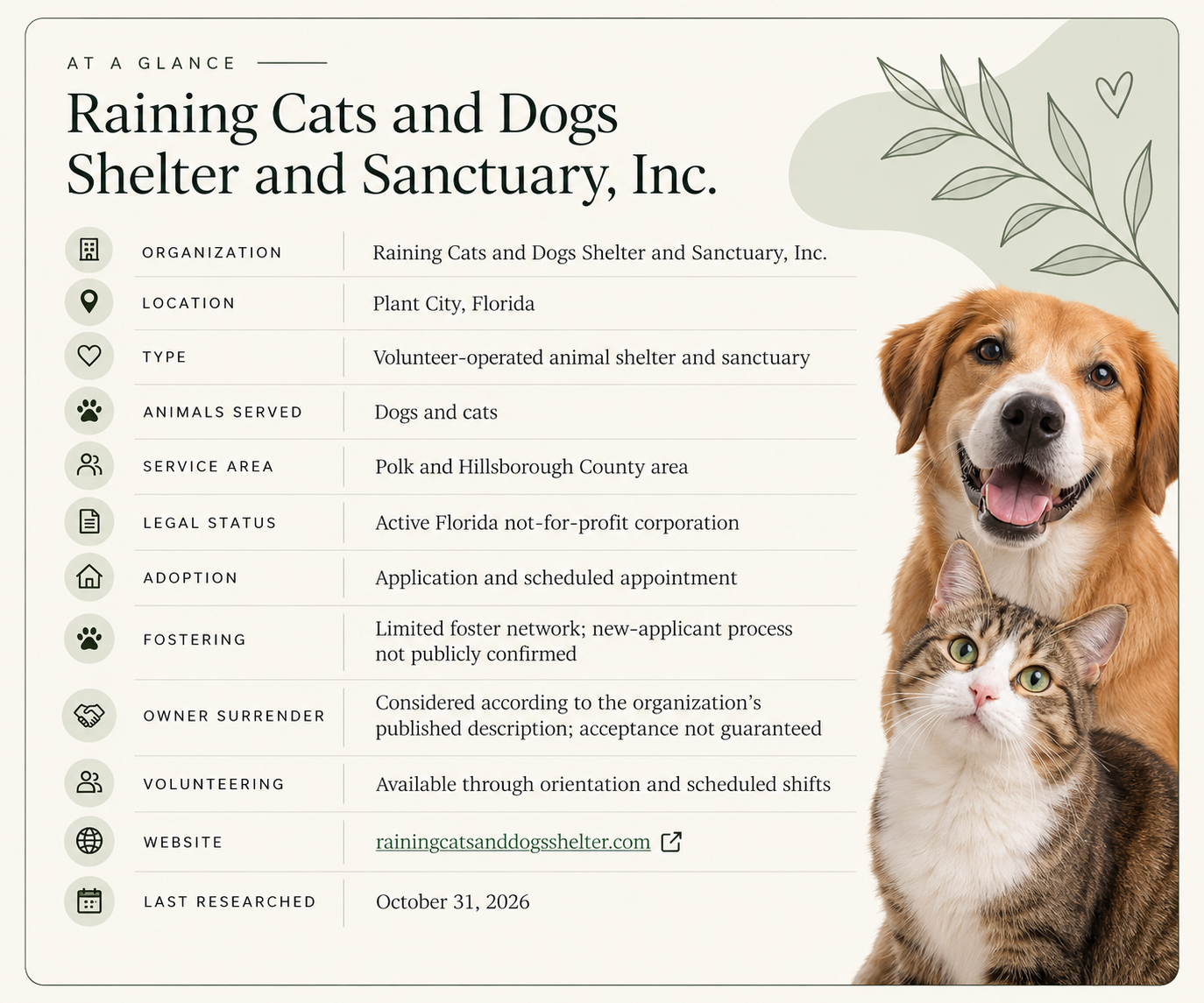
In Plant City, Florida, Raining Cats and Dogs Shelter and Sanctuary provides care for cats and dogs who need temporary shelter, a new home, or a safe place to remain when adoption is difficult.
The volunteer-run organization partners with municipal shelters to help at-risk animals in Polk and Hillsborough County. Its approach includes adoption, specialized foster care, and long-term sanctuary care for animals whose age, health, or behavior may make placement more challenging.
For this month's Rescue of the Month, The Green Muse is highlighting the sanctuary's work, its ongoing veterinary expenses, and the practical ways community members can help.
This guide also explains how to adopt, volunteer, inquire about an animal in need, and contact the organization directly.
About Raining Cats and Dogs Shelter and Sanctuary
Established in 2017, Raining Cats and Dogs Shelter and Sanctuary was created around a particular need: providing care for animals without imposing a fixed deadline on how long they can remain.
Some animals are adopted relatively quickly. Others need time to recover from illness, become comfortable around people, or adjust to a new environment. For certain animals, the shelter may become their long-term home.
The organization describes its sanctuary residents as animals who may be elderly, fearful, or difficult to place through conventional adoption.
Rather than requiring every animal to follow the same path, the sanctuary allows care and placement decisions to reflect individual circumstances.
Its facility is a modified house rather than a conventional municipal shelter. Volunteers provide daily care, maintain the property, and help animals become accustomed to different people.
The organization states that it operates without paid employees or taxpayer funding for its shelter expenses.
What Does the Sanctuary Do?
Shelter and adoption services
The sanctuary houses dogs and cats while seeking suitable adoptive homes. Its adoption process emphasizes compatibility between an animal's needs and a prospective family's circumstances.
Long-term sanctuary care
Some residents remain for extended periods because of medical conditions, age, or behavioral needs.
The organization explains that these animals may still be considered for adoption under appropriate circumstances, although not every sanctuary resident is available for general public adoption.
Foster care for animals with additional needs
The shelter maintains a small foster network involving existing volunteers.
According to its website, foster homes are used for very young, elderly, or sick animals, as well as animals who are not thriving in the shelter environment.
Veterinary care
Veterinary treatment is an important part of the sanctuary's work.
Its published Hearts & Smiles fundraising campaign identifies heartworm treatment and dental procedures as two major expenses. The organization also describes providing routine heartworm and flea prevention for dogs in its care.
These costs help explain why financial contributions remain important even when a shelter's animals already have a safe place to stay.
A Current Need: Veterinary Care and Hearts & Smiles
The sanctuary's Hearts & Smiles fundraiser is scheduled for November 9, 2026, at Keel Farms in Plant City.
The campaign focuses on raising money for heartworm treatment and dental care for shelter animals.
According to the organization:
Heartworm treatment for a small or medium-sized dog costs approximately $750.
Dental procedures involving bloodwork, X-rays, and extractions generally cost $1,200–$1,800.
Monthly heartworm and flea prevention creates an additional recurring expense.
These are costs reported by the sanctuary and may change.
The campaign provides a concrete opportunity for supporters to contribute toward medical care. Readers who cannot attend the event can use the organization's official donation channel.
Learn more: https://www.rainingcatsanddogsshelter.com/heartsandsmiles
Need Animal-Related Help? Start Here
Raining Cats and Dogs is a private rescue and sanctuary, not a municipal animal-control agency or emergency veterinary service.
Before contacting the organization, it is important to understand which services are publicly documented and which require direct confirmation.
I found a stray or injured animal
The sanctuary works with municipal shelters to help certain at-risk animals, but its website does not establish that it provides public stray-animal pickup or accepts every found animal.
If you have found an animal, contact the appropriate local animal services agency for guidance. If the animal is injured or in immediate danger, contact an emergency veterinarian or the appropriate emergency animal-response service.
You may contact the sanctuary to ask whether it can offer guidance, but do not assume that it has space or can accept the animal.
I need to surrender or rehome my pet
The sanctuary states that it tries to accept owner-relinquished animals when possible.
However, specific eligibility requirements, fees, waiting periods, and intake procedures were not publicly confirmed at the time of publication.
Before visiting, contact the organization directly, explain your circumstances, and ask whether it is currently considering owner-surrender requests.
Do not bring an animal to the property without prior arrangements.
I need help keeping my pet
The sanctuary's published information primarily describes sheltering, adoption, sanctuary care, and veterinary care for animals within its organization.
Publicly available information does not confirm that it offers pet food assistance, financial assistance to owners, subsidized veterinary treatment, or temporary boarding for community pets.
If you need one of these services, contact local animal services or established community pet-support programs to identify appropriate resources.
I need emergency animal assistance
Raining Cats and Dogs is not publicly identified as a 24-hour emergency response provider.
For an animal requiring immediate medical attention, contact an emergency veterinary hospital. For dangerous situations, animal cruelty reports, or animal-control matters, contact the appropriate local authority.
How to Adopt from Raining Cats and Dogs
The organization uses an application-based adoption process.
Prospective adopters begin by completing the application on its website. The shelter reviews applications and conducts veterinary reference checks as part of its published Pawsome Pairings process.
Once approved, applicants can discuss potentially suitable animals with the adoption coordinator and arrange a meet-and-greet.
Meet-and-greets at the Plant City shelter are scheduled on Saturdays by appointment. Walk-in adoption visits are not available.
The sanctuary also lists adoptable cats at participating PetSmart locations in Lakeland and Brandon. Visits to these stores are possible during store operating hours, but adoption meet-and-greets require an approved application.
Adoption fees and individual eligibility requirements should be confirmed directly. Apply here.

Available animals
Foster homes help the sanctuary care for animals whose needs may be difficult to meet in a shared shelter environment.
The organization confirms that it uses a small network of foster caregivers who are also shelter volunteers.
A separate public application process for new foster caregivers, along with eligibility requirements and the division of expenses, was not confirmed.
Anyone interested in fostering should contact the organization to ask whether additional caregivers are currently needed and what participation would involve.
How to Volunteer
Volunteers carry out much of the sanctuary's daily work, including cleaning, animal care, and general shelter maintenance.
The published volunteer process begins with contacting the volunteer coordinator and completing the required release form.
New-volunteer orientations are held on Saturdays by prior arrangement and last approximately two hours. Volunteers who are a suitable fit may then be scheduled for a four-hour shadow shift.
The minimum volunteer age is 18.
Volunteer opportunities are listed seven days a week between 11 a.m. and 3 p.m., but participation must be arranged in advance.
Volunteer information. Volunteer coordinator.
How to Support the Sanctuary
Financial donations help cover veterinary treatment and the continuing costs of caring for shelter residents.
Supporters can contribute through the organization's official donation platform, purchase requested supplies through its published Amazon wish list, volunteer, or explore adoption opportunities.
Sharing verified adoption profiles can also help individual animals reach prospective adopters whose homes may suit their needs.
Official donation page. Amazon wish list.
Supporters should confirm current needs before purchasing or delivering supplies.
Before You Contact the Rescue
Having clear information ready can help volunteers understand your request.
If you are asking about an animal, consider providing:
Your location and the animal's approximate age and species.
Clear photographs, when available.
Known medical or behavioral concerns.
Whether the animal is owned, found, or already in temporary care.
The urgency of the situation and any relevant deadlines.
Providing this information does not guarantee that the sanctuary can offer assistance.
Contact Raining Cats and Dogs Shelter and Sanctuary
-
2708 East State Road 60, Plant City, FL 33567
-
-
-
-
-
-
Visits are by appointment only. Contact the sanctuary before traveling to its location.
Why Long-Term Animal Sanctuaries Matter
Adoption is an important part of animal welfare, but not every animal can move immediately into a new home.
Some need prolonged medical care. Others need patient behavioral support, familiar routines, or a living environment that accommodates their limitations.
Sanctuaries can provide an additional option within the broader rescue system by caring for animals whose needs do not fit a typical adoption timeline.
That work requires sustained resources, including veterinary care, suitable housing, experienced caregivers, and community support.
For people interested in helping, understanding an organization's actual needs is often the most useful place to begin.
Frequently Asked Questions
-
The organization is located at 2708 East State Road 60 in Plant City, Florida. Visits require an appointment.
-
Yes. Its published mission includes temporary and long-term care for dogs and cats.
-
Yes. Adoption begins with an online application, followed by review and an appointment when appropriate.
-
The organization says it tries to accept owner-relinquished animals, but current intake capacity and detailed requirements must be confirmed directly.
-
Yes. The organization has a published volunteer process, including orientation and a shadow shift. Volunteers must be at least 18.
-
The sanctuary uses a small foster network. Whether it is accepting additional foster caregivers was not publicly confirmed at the time of publication.
-
Use the official donation page linked from the organization's website.
-
It is not publicly identified as an emergency veterinary or animal-control service. For immediate emergencies, contact the appropriate local provider.
Every Animal Deserves a Chance to Be Cared For
For some animals, finding a home takes longer. Some need medical treatment, others need time to learn to trust, and a few may spend the rest of their lives in the care of a sanctuary. Their needs may be different, but their lives are no less deserving of comfort, patience, and kindness.
Organizations like Raining Cats and Dogs Shelter and Sanctuary remind us that animal welfare is about more than finding homes. It is also about making sure animals are cared for while they wait, and that those who cannot be adopted are not forgotten.
Support does not always have to be financial. Sometimes it begins with sharing an adoption profile, offering a few hours of your time, or helping someone discover a rescue they never knew existed.
Every act of care matters, especially to the animals still waiting.
Continue Exploring: Rescue of the Month
Raining Cats and Dogs is one of the organizations we're bringing into focus through The Green Muse's Rescue of the Month series.
We invite you to visit our Rescue of the Month page to learn more about this sanctuary, explore previously featured rescues, and discover meaningful ways to support the people and organizations working for animals in need.
Because the more we understand their work, the more thoughtfully we can help.

Please note: The Green Muse is not affiliated with this organization unless explicitly stated. Information in this feature is gathered from publicly available sources and is provided for educational and awareness purposes. Rescue policies, intake availability, adoption requirements, programs, hours, fees, and contact information can change. Please contact the organization directly for the most accurate and current information.
Last researched and verified by The Green Muse: October 31, 2026.
-
At The Green Muse, we believe that conscious living begins with curiosity, compassion, and access to trustworthy information. Through our articles on sustainable living, ethical fashion, mindful consumption, and animal welfare, we aim to make thoughtful choices more accessible without encouraging perfection or unnecessary consumption.
Transparency, editorial independence, and respect for our readers guide how we research, create, and maintain our content.
Editorial Integrity & Research
Our articles combine independent research, credible publications, publicly available information, and thoughtful editorial analysis. We may use digital research tools, trend analysis, and AI-assisted platforms to help gather, organize, and review information.
All content is reviewed before publication, with sources cross-checked where practical. We recognize that research evolves, information can become outdated, and no source or technology is infallible.
Our articles are intended to encourage informed decisions and further exploration, not to present any single lifestyle, product, or approach as the only responsible choice.
Affiliate Links & Brand Partnerships
Some articles contain affiliate links. When readers make qualifying purchases through these links, The Green Muse may earn a commission at no additional cost to them.
Affiliate partnerships help support our independent editorial work. We aim to feature brands, products, and services that are relevant to our content and consistent with our values. Commercial relationships do not guarantee favorable coverage or determine our editorial conclusions.
We encourage readers to consider their individual needs, research products independently, and make purchases thoughtfully.
External Links, Product Availability & Archived Content
Our articles may reference sustainable brands, products, nonprofit organizations, educational resources, and other third-party websites.
As brands evolve, products are discontinued, organizations update their websites, and affiliate programs change, some external links may become outdated, redirect, or stop working altogether.
We review and update content as resources allow, but cannot guarantee the continued availability, accuracy, pricing, or functionality of third-party websites and links. The inclusion of an external resource does not constitute an endorsement of every product, policy, or practice associated with that website.
Older articles remain part of our educational archive and may reflect information available at the time of publication. Readers are encouraged to verify current details directly with the relevant organizations or providers.
Animal Welfare, Rescue Advocacy & Adoptable Pets
Animal welfare is an important part of The Green Muse. Through educational articles, rescue resources, and The Green Muse Adoptables, we help raise awareness of shelter animals, responsible adoption, fostering, and the work of animal welfare organizations.
Our advocacy is independent and primarily volunteer-based. We are not a shelter, rescue organization, veterinary provider, or adoption agency. Unless explicitly stated, featuring an organization or animal does not imply an official affiliation, employment relationship, or financial compensation.
When sharing adoptable animals, we rely on information provided by shelters, rescue organizations, and other authorized sources. We make reasonable efforts to check and update information, but adoption status, location, medical details, and eligibility can change without notice.
All adoption inquiries, applications, and placement decisions must be handled directly by the responsible shelter or rescue organization.
Rescue Resources, Donations & Third-Party Organizations
Links to animal shelters, rescue groups, nonprofit organizations, donation pages, wishlists, and community programs are shared to help readers discover ways to support animal welfare.
The Green Muse does not operate or control these third-party organizations or their websites. We cannot guarantee their current practices, policies, fundraising activities, availability, or outcomes.
Readers should verify donation information, adoption procedures, and organizational details directly before making financial commitments or participating in programs.
Educational Information & Professional Guidance Content published on The Green Muse is provided for general educational and informational purposes.
Discussions involving sustainability, environmental practices, animal health, shelter operations, adoption requirements, and related subjects should not replace guidance from qualified professionals.
For veterinary, medical, legal, or other specialized matters, readers should consult appropriately qualified professionals and the organizations directly responsible for individual cases.
Images, Creative Assets & Copyright
Images and creative materials featured on The Green Muse may come from licensed image libraries, design platforms, participating brands, photographers, shelters, rescue organizations, and other credited sources.
These may include Pexels, Unsplash, Canva, Getty Images, and materials supplied by organizations featured in our content.
Images are used according to applicable licenses, permissions, or other lawful grounds. Unless otherwise stated, copyright and ownership remain with their respective rights holders. Their appearance on our website does not imply that The Green Muse owns the original works or that the creators endorse our content.
Corrections, Updates & Community Collaboration
We welcome corrections and updated information from readers, brands, shelters, rescue organizations, and community partners.
Although we work to maintain accurate and useful content, information may change after publication. If you notice an outdated resource, broken link, incorrect attribution, or an animal profile requiring an update, please contact us.
Your input helps us maintain a more reliable and respectful educational resource for our community.
Contact: hello@thegreenmuseblog.com
Thank you for reading with curiosity, supporting independent content, and helping us build a more thoughtful relationship with the world around us.
















A Note on Information & Community Respect
This article is shared for educational and awareness purposes. While we strive to provide accurate, reliable information, we encourage readers to explore additional sources and conduct their own research, as information and circumstances may change over time. When applicable, please verify current details directly with the shelter, rescue organization, or relevant official source.
We also ask that discussions remain kind, respectful, and constructive. Thoughtful conversations help us build a supportive community where animal welfare remains the priority.
Thank you for being part of a community that cares.

Meet Raining Cats and Dogs Shelter and Sanctuary, a volunteer-run Florida organization providing adoption and long-term care for dogs and cats. Explore its programs, current needs, and ways to help.