Rescue of the Month: The Pet Cottage
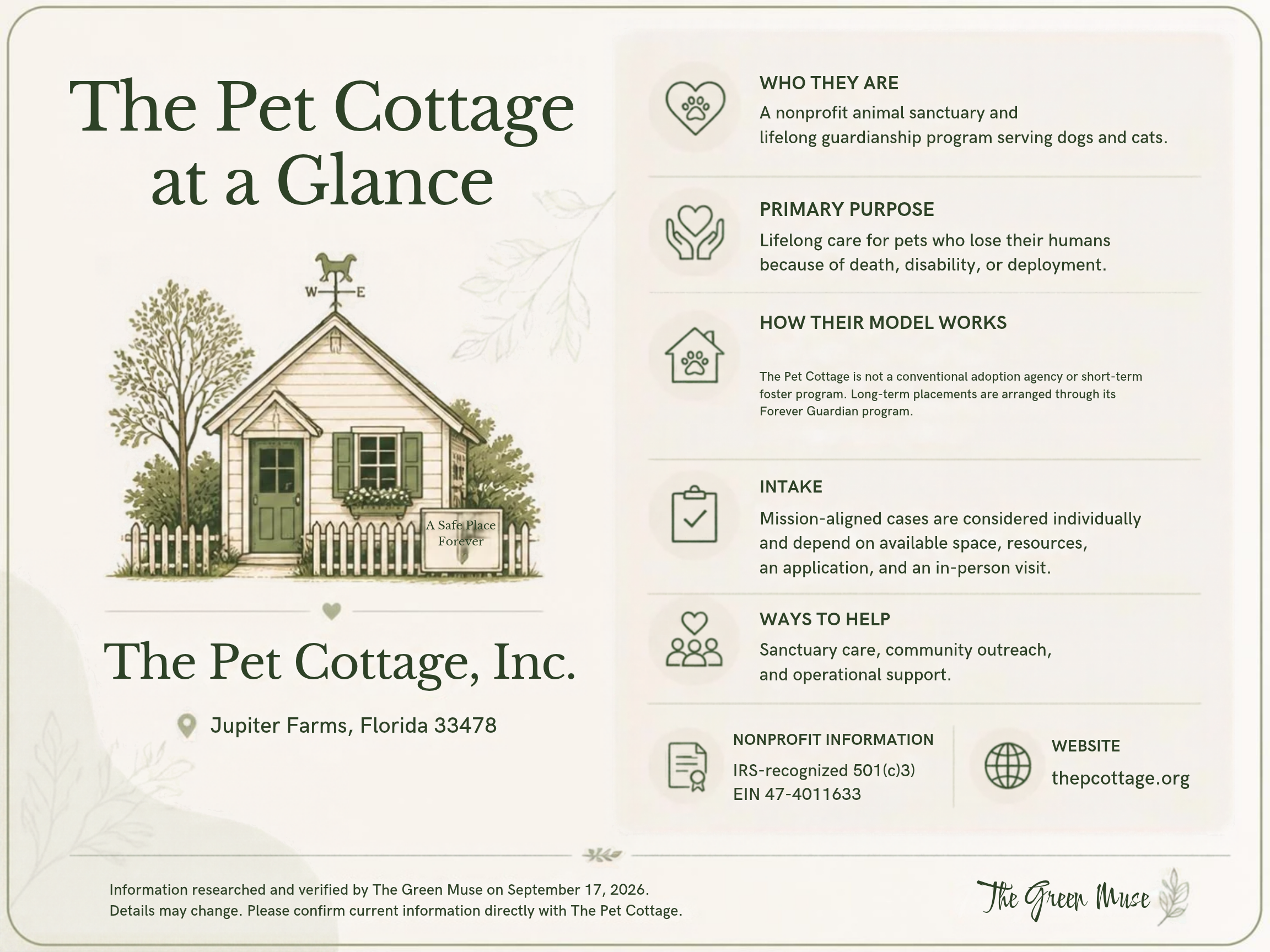
The Pet Cottage offers a different kind of safety net for dogs and cats whose people can no longer care for them because of death, disability, or deployment. This guide explains its lifelong guardianship model, case-by-case intake process, and ways to help.
What happens to a beloved pet when their person dies, develops a disability, or is deployed and no longer has anyone able to provide care?
The Pet Cottage was created around that question. Based in Jupiter Farms, Florida, the nonprofit provides lifelong, homestyle care for dogs and cats accepted into its program. Some live at its two-acre sanctuary. Others share a home with a volunteer Forever Guardian, while The Pet Cottage remains responsible for their veterinary care and long-term wellbeing.
This is not a traditional shelter, adoption agency, or temporary foster network. The distinction matters, especially for someone searching for immediate help. This guide explains what The Pet Cottage does, who may be able to seek assistance, how its guardianship model works, and where to find current information before making plans.
About The Pet Cottage
Founder Wendy Derhak established The Pet Cottage in 2012 after helping her friend Joan plan for the care of her three cats while facing a terminal illness. What began as a personal promise became an organization focused on a concern many pet guardians carry quietly: who will care for my animal if I cannot?
According to the organization, The Pet Cottage can care for up to 20 pets at its Jupiter Farms sanctuary and 50 through its Lifelong Guardianship Program. These numbers describe its stated program capacity, not guaranteed current availability. Intake depends on whether the organization believes it can uphold its commitment to care for an animal for life.
The model has two parts:
Sanctuary residency: Pets who need closer supervision or more medical support may live at the Jupiter Farms property, where they receive homestyle care from staff and volunteers.
Life with a Forever Guardian: Other pets live in private homes with approved guardians. The guardian provides a safe home, daily care, food, exercise, and companionship. The Pet Cottage says it covers routine, specialty, and emergency veterinary care, along with prescriptions and preventatives, for animals in its program.
Forever Guardians do not adopt the animals in the conventional sense. The Pet Cottage retains its lifelong commitment, including a plan for the animal if a guardian’s circumstances change.
What does The Pet Cottage do?
Lifelong care after death, disability, or deployment
The organization considers dogs and cats who need a new home because their person has died, become unable to provide care due to disability, or been deployed. Every request is reviewed individually. Acceptance is not automatic and depends on capacity, resources, and whether the animal is a suitable fit for the program.
Once accepted, an animal lives either at the sanctuary or with a Forever Guardian. The organization describes its commitment as permanent: the animal remains part of its program for life.
Supported companionship for older adults and people with disabilities
The program also connects some pets with senior people and others who want animal companionship but may hesitate to assume full ownership without a long-term safety net. The Pet Cottage supports these placements with veterinary coverage and regular check-ins, while the guardian provides the pet’s home and daily care.
Veterinary and behavioral support for animals in its care
For pets already accepted into the program, The Pet Cottage reports that it provides veterinary care, medications, wellness checks, and behavioral training when needed. This support belongs to its lifelong guardianship model; the website does not present the organization as a general low-cost veterinary clinic or an open financial-assistance program for community pets.
Future care planning
The organization’s Secure Lifetime Care program allows pet owners to plan for their animals through a written agreement and a funded bequest. Its website says the arrangement includes advance planning, emergency contacts, veterinary and behavioral records, and future placement through either sanctuary residency or a Forever Guardian home. Anyone considering this option should speak directly with The Pet Cottage and seek independent legal and financial advice before changing an estate plan.
Need help? Start here
I need to rehome a pet after a death, disability, or deployment
This is the type of situation The Pet Cottage is designed to consider. Its rehoming process begins with a conversation. If the situation may fit the program, the next steps include an application and an in-person visit to assess whether the animal is a suitable candidate.
The organization requests a minimum contribution of $3,000 toward lifetime care for an accepted pet. People who cannot contribute that amount may apply to the Pawsitively Perry Fund for possible support. Applying to the fund does not guarantee assistance or intake.
Before making plans, contact The Pet Cottage directly. The website does not publish a guaranteed turnaround time, a public waitlist policy, or a defined geographic eligibility area.
I need to surrender my pet for another reason
The public rehoming information is specifically framed around death, disability, or deployment. It does not confirm a general owner-surrender program for circumstances outside that mission.
You may contact the organization to explain the situation, but do not assume it can accept the animal. If the need falls outside its program, contact local municipal shelters, established rescue groups, veterinary offices, and humane rehoming resources for additional options.
I found a stray or injured animal
The Pet Cottage does not publicly identify itself as a stray-intake organization, animal-control agency, or emergency veterinary service. Its website does not confirm that it accepts found animals.
For a stray animal, contact the animal-control or municipal shelter serving the location where the animal was found. If the animal is injured or in immediate danger, contact a local emergency veterinary hospital or the appropriate public-safety authority. A veterinary clinic or shelter can also advise you about checking for a microchip.
I need help keeping my pet
The Pet Cottage’s public programs focus on lifetime guardianship, not general pet food, low-cost veterinary, temporary foster, or behavior-assistance services for pets who remain with their owners. The publicly described Pawsitively Perry Fund helps eligible applicants with the contribution requested for an animal entering a Pet Cottage lifetime-care program; it is not presented as a general veterinary or household assistance fund.
If your goal is to keep your pet at home, ask your local shelter, humane society, veterinarian, or 211 service about pet-food banks, low-cost veterinary care, behavior support, and temporary-crisis programs available in your area.
I need emergency animal help
The Pet Cottage is not presented as a 24-hour emergency service. For an animal experiencing a medical emergency, contact an emergency veterinary hospital. For an animal in immediate danger, suspected cruelty, or a loose animal creating a public-safety risk, contact the appropriate local animal-control or law-enforcement agency.
Can I adopt from The Pet Cottage?
The Pet Cottage clearly states that it is not an adoption agency. Its Available Pets page supports its guardianship work rather than conventional adoption.
People interested in sharing their home with a Pet Cottage animal can apply to become a Forever Guardian. Because available animals and appropriate matches change, review the organization’s current listings and application information before assuming that a particular pet is available.
How to become a Forever Guardian
A Forever Guardian gives an approved Pet Cottage animal a stable home and daily companionship without taking on conventional ownership alone. The organization says it covers routine, specialty, and emergency veterinary care, prescription medications, and preventatives. Guardians provide food, daily exercise, attention, and a safe home.
Many animals in the program are seniors or have health needs. A placement should therefore be approached as a lasting care relationship, not a short-term foster arrangement. Interested applicants can complete the official Forever Guardian application. Eligibility details, matching timelines, home requirements, and geographic limits were not fully stated on the public information reviewed; confirm these directly with the organization.
How to volunteer
The Pet Cottage lists several ways to contribute time:
Sanctuary care: walking dogs, spending time with cats, laundry, tidying, and organizing donations.
Community outreach: distributing information, photographing pets and volunteers, helping with events and fundraisers, and supporting community activities.
Operational support: assisting with pharmacy and donation intake, clerical work, and supporter correspondence.
Remote help: the organization notes that some contributions can be made remotely, although specific current roles should be confirmed.
Start with the official volunteer application. Publicly available information did not fully confirm age requirements, schedules, orientation steps, or transportation requirements.
How to support The Pet Cottage
Supporters can use the organization’s official website to:
make a one-time or recurring donation;
apply to volunteer or become a Forever Guardian;
explore business sponsorship;
discuss in-kind gifts or current supply needs directly with the organization;
learn about planned giving and its Legacy Society; or
share accurate information about its specialized lifetime-care model.
Use official channels and confirm present needs before purchasing or delivering supplies.
Before you contact The Pet Cottage
Having clear information ready can help the team understand whether the request may fit its mission:
your name, location, phone number, and email;
your relationship to the animal;
the reason lifelong rehoming is needed;
the animal’s species, age, sex, breed, and weight, if known;
medical history, medications, and veterinary records;
spay or neuter and vaccination status;
behavior around adults, children, dogs, cats, and other animals;
photos and microchip information;
the animal’s current living situation and the date care is needed;
any person currently able to provide temporary care; and
what, if anything, you can contribute toward lifetime care.
Providing this information does not guarantee acceptance. The organization makes decisions case by case according to its available space and resources.
Contact The Pet Cottage
Website: www.thepetcottage.org
Rehoming inquiries: Rehome with The Pet Cottage
Forever Guardian application: Apply to become a Forever Guardian
Volunteer application: Volunteer with The Pet Cottage
Financial-support application for lifetime guardianship: Pawsitively Perry Fund
Donate: Official donation page
Contact page: Send a message
Email: ThePetCottage@hotmail.com
Phone: 561-818-5025
Location: Jupiter Farms, Florida 33478
The public website does not list a street address or public visiting hours. Contact the organization before traveling to the sanctuary or bringing an animal or supplies.
Important intake note
The Pet Cottage is small and mission-specific. Its website states that it cannot accept every animal referred to it, and acceptance depends on its ability to make a lifelong commitment. Space, funding, staffing, and guardian availability can change.
Contact the organization for current information before traveling, arranging an animal’s surrender, delivering supplies, or assuming help is available. If a situation is time-sensitive, continue contacting other appropriate local resources while awaiting a response.
Why this model matters
Animal welfare is often discussed through adoption and shelter intake, but continuity of care is another important part of the picture. Illness, aging, death, disability, and military deployment can separate people from animals they deeply value. Planning before a crisis gives families more choices and helps reduce sudden, unstable transitions for pets.
The Pet Cottage addresses a narrow but meaningful gap: permanent care when a pet’s person can no longer remain responsible for them. Its guardianship model also allows some older adults and people with disabilities to share life with an animal while supported by an organization that maintains long-term responsibility for the pet.
The lesson extends beyond one nonprofit. Every pet guardian can identify an emergency caregiver, keep medical records accessible, discuss their wishes with family, and include enforceable pet-care arrangements in legal and financial planning. Those quiet preparations can make an uncertain moment gentler for both animals and people.
Frequently asked questions
-
The organization is based in Jupiter Farms, Florida 33478. Its public website does not list a street address or visiting hours, so contact the team before planning a visit.
-
Its public materials describe lifelong care for dogs and cats. Some animals live at the sanctuary, while others live with approved Forever Guardians.
-
No. The organization explicitly states that it is not an adoption agency or foster program. People wishing to welcome one of its animals into their home can explore its Forever Guardian program.
-
It considers pets needing rehoming because of death, disability, or deployment on a case-by-case basis. Acceptance depends on space, resources, an application, an in-person visit, and the organization’s ability to provide lifelong care.
-
For an accepted pet, the organization requests a minimum $3,000 contribution toward lifetime care. People unable to meet that amount may apply to the Pawsitively Perry Fund. Neither an application nor a request for financial support guarantees acceptance.
-
The website does not confirm stray intake. The Pet Cottage is not presented as an animal-control agency or open-intake shelter. Contact the municipal shelter or animal-control agency serving the area where the animal was found.
-
A Forever Guardian provides a Pet Cottage animal with a home, food, exercise, and daily care. The Pet Cottage says it retains its lifelong commitment to the pet and pays for routine, specialty, and emergency veterinary care, prescriptions, and preventatives.
-
The public website does not describe a general emergency-veterinary or community financial-assistance service. The Pawsitively Perry Fund is specifically connected to the requested contribution for eligible pets entering a lifetime guardianship program.
-
Call 561-818-5025, email ThePetCottage@hotmail.com, or use the official contact form.
Please note: The Green Muse is not affiliated with this organization unless explicitly stated. Information in this feature is gathered from publicly available sources and is provided for educational and awareness purposes. Rescue policies, intake availability, adoption requirements, programs, hours, fees, and contact information can change. Please contact the organization directly for the most accurate and current information.
Last researched and verified by The Green Muse: September 17, 2026.
-
At The Green Muse, we use our platform to support animal welfare through education, awareness, and ethical advocacy. When we highlight rescues, shelters, or adoptable animals, we do so as independent advocates and volunteers. We are not financially compensated, contracted, or acting as official representatives of any organization unless explicitly stated.
Our role is to help amplify life-saving work, share accurate information when available, and encourage informed, compassionate action within the animal rescue community.
-
Links to external websites — including rescue pages, nonprofit organizations, donation platforms, and wishlists — are provided for informational and awareness purposes only. The Green Muse does not own, operate, or control these third-party sites and is not responsible for their content, availability, policies, or outcomes.
We encourage readers to conduct their own due diligence, ask questions directly, and support organizations in ways that feel aligned and responsible to them.
-
All content published on The Green Muse is intended for educational and awareness purposes. Articles discussing shelter systems, rescue terminology, animal welfare practices, or advocacy topics are not a substitute for professional advice, veterinary care, legal counsel, or direct communication with shelters or rescue organizations.
Situations involving animal health, behavior, intake decisions, or adoption requirements can vary widely. When considering adoption, fostering, transport, or medical care, always consult qualified professionals and the organizations directly involved.
-
We are committed to maintaining an ethical, accurate, and respectful Rescue Directory and educational resource library. While we research and verify information to the best of our ability, details can change quickly within shelter and rescue systems.
If you are affiliated with an organization listed — or notice outdated or incorrect information — we welcome your input. Community collaboration helps ensure animals, advocates, and organizations are represented with care, clarity, and integrity.
📩 Contact: hello@thegreenmuseblog.com
